article
What Is a Good Venture Client Company?
The 6 structural indicators that separate top-tier Venture Clients from corporate innovation theater.

Summary
Today, many companies adopt startup technologies through procurement or M&A to drive product and process innovation. This practice—Venture Clienting—means established firms act as the clients, or users, of venture-backed entrepreneurial solutions. To maximize effectiveness, a growing number of firms are institutionalizing this activity as a distinct business discipline by establishing dedicated Venture Client Units. Applying these distinct routines—rather than relying on generic procurement or investment-driven Corporate Venture Capital (CVC)—can significantly boost the impact of startup solutions on competitiveness.
As this novel corporate venturing approach is applied globally, a critical question emerges: what makes a good Venture Client? This requires defining both the structural indicators and the hard metrics of excellence. While identifying a top-tier venture investor is a straightforward comparison of financial returns, measuring Venture Clienting excellence requires a deeper look into the organization.
In this article, I introduce a rigorous diagnostic framework to answer this question. Based on a multi-year longitudinal study of the practice across global enterprises, I outline six structural indicators that define high-impact Venture Clienting. These range from the C-level mandate and problem-sensing capabilities to operational efficiency and a strict “user-first” cultural mindset.
Whether you are an executive looking to audit and scale your startup adoption capabilities, or a startup founder determining which firms are actually worth your time, this framework provides a pragmatic blueprint for excellence in Venture Clienting.
Key Takeaways
- Venture Clienting requires structural excellence: Adopting startup technology is a strategic imperative for the modern enterprise. However, achieving high impact is not automatic; it demands maturity across six structural indicators.
- Cement a C-level mandate: Excellence begins at the board level. A documented strategic purpose for startup technology adoption is the critical foundation for the entire discipline.
- Sense the startup gap: Startups exist to address unsolved business needs, both known and unknown. Top-tier Venture Clients systematically sense hundreds of the exact problems that startups solve best—every year.
- Attract top-tier startups: Elite startups solve complex problems; mediocre ones introduce operational risk. A good Venture Client does not settle for average and builds the operational magnetism required to attract the best.
- Demand measurable impact: Startups are funded because their solutions deliver substantial ROI for their clients. Good Venture Clients convert these novel technologies into tangible competitive advantage—direct revenue or cost savings.
- Pursue operational efficiency: Adopting startup technology is complex. Good Venture Clients ensure the strategic impact of a solution significantly outweighs the time and cost required to adopt it.
- Adopt a user-first mindset: For a good Venture Client, the value of a startup lies in the adoption of its solution, not in the financial speculation of its equity.
The Genesis of Venture Clienting
I coined the term “Venture Client” in 2014 at BMW R&D. We needed a new organizational capability. The goal was simple but structurally difficult: adopt startup technologies systematically, at speed, at low cost, and at scale.
Like many Fortune 500 companies, BMW had integrated startup technology for decades. But we relied on generic business functions—procurement, technology scouting, and open innovation initiatives. These functions failed to deliver. Internal rejection rates were high. Adoption was rare. Strategic impact was unmeasurable.
To fix this, established firms typically turn to Corporate Venture Capital (CVC). But CVC is an investment vehicle, not an adoption engine. It is capital-intensive, highly selective, and structurally constrained. Worse, CVC limits a firm’s scope. Via CVC, a company can only access startups that are actively raising capital and willing to accept a strategic investor. If a startup does not accept corporate capital, CVC cannot help the firm access its technology.
We needed a new logic. One centered primarily on adopting startup technology. A controlling investment (M&A) could be an optional tool, used for example if exclusive control over the startup technology was necessary.
This led to the Venture Client Model. In 2015, I launched the BMW Startup Garage—the world’s first dedicated Venture Client Unit. It established Venture Clienting as a formalized business discipline.
Today, the model has scaled globally. Industry leaders like Bosch, Siemens, and Holcim have built their own units. Top-tier academic institutions now research and teach the discipline. The pioneer here is Professor Andreas König, Chair of Strategic Management, Innovation, and Entrepreneurship at the University of Passau. Other forward-thinking schools followed soon after, including IMD, INSEAD, Berkeley, Wharton, HHL, IESE, TU Munich, ETH, and WHU. INSEAD even published a dedicated case study on the BMW Startup Garage.
Because of this rapid global diffusion, the market needed a neutral, shared reference layer. That is what gave rise to VentureClient.org.
In this article, I define what a Venture Client is—and more importantly, the six indicators that separate the good ones from the rest.
What Is a Venture Client? Defining the Usage-Centered Logic
At its core, a Venture Client is any organization that uses a startup’s product to solve a business need. This usage can happen via any business transaction—from a standard purchase order to a controlling M&A. Because the definition is based purely on usage, almost every company qualifies. Today, there are few organizations that are not Venture Clients of AI startups like OpenAI or Anthropic. Yet, while the definition is simple, the strategic logic behind the term is profound.
I coined the term “Venture Client” for two reasons. First, to highlight the unique impact-to-risk ratio inherent to the startup ecosystem. Startup solutions offer substantially more impact than those of incumbents, but they come with significant operational risk because startups are founded to solve complex problems that established players cannot. Second, to emphasize the need for distinct organizational capabilities. To be a good Venture Client, a company must be highly effective at extracting that massive impact while systematically mitigating the inherent risk.
My inspiration for this logic was the Venture Capital model. VCs know that startups have the potential for exponential returns precisely because they solve massive strategic problems. They also know this potential comes with extreme risk. Applying a traditional investment model—like buying public equities—would guarantee failure in the startup ecosystem. To extract maximum profit from startup equity while managing the downside, VCs had to invent a completely distinct investment model.
Venture Clients must do the exact same thing. Just as writing a check does not make you a top-tier VC, using a startup technology does not make you a good Venture Client. Startups are fragile, their products are less proven, and they can look like the next Microsoft today but close down next month due to a founder conflict. To succeed, corporations cannot rely on generic routines; they must build distinct capabilities that maximize strategic impact while neutralizing operational risk.
The price of poor execution is severe. Bad integration wastes time, capital, and resources, and can even allow immature technology to harm the firm’s current and future business. But while adopting the wrong startup is a risk, missing out on a game-changing technology is a critical strategic threat. Consider Bosch. In the early 2000s, the firm failed to adopt Mobileye’s early vision systems, operating under the assumption that it could develop a better solution internally. This oversight had a twofold cost: Bosch missed out on billions in potential revenue and forfeited the opportunity to assume a leadership role in the emerging market for autonomous driving technology. Conversely, consider Apple in 1984. Steve Jobs discovered Adobe operating out of a garage, saw the potential of its technology, and convinced the founders to license it to Apple. That single adoption earned Apple market leadership in the billion-dollar laser printer market, proving the immense power of successful Venture Clienting.
Despite these high stakes, most firms are highly ineffective at Venture Clienting. Many lack distinct capabilities altogether, while others implement inadequate, superficial processes. Consequently, the corporate venturing landscape is littered with “David versus Goliath” stories—endless pilots, procurement bottlenecks, culture clashes, and billions in wasted capital that fails to drive innovation.
Identifying a good VC is easy: you just compare financial ROIs. Identifying a good Venture Client requires looking at structural indicators. Before a company can figure out how to build a world-class Venture Client capability, it must first understand what excellence looks like and why its current approach is failing. Therefore, this article focuses on how to tell good from bad. In the next section, I define the six indicators that separate the best from the rest. This framework serves a dual purpose. For established firms, it is a diagnostic tool to audit their operations and identify what must change. For startups, it is a critical filter to determine which enterprise Venture Clients are worth their time and which they should avoid.
The 6 Structural Indicators of a Good Venture Client Company (The Diagnostic Framework)
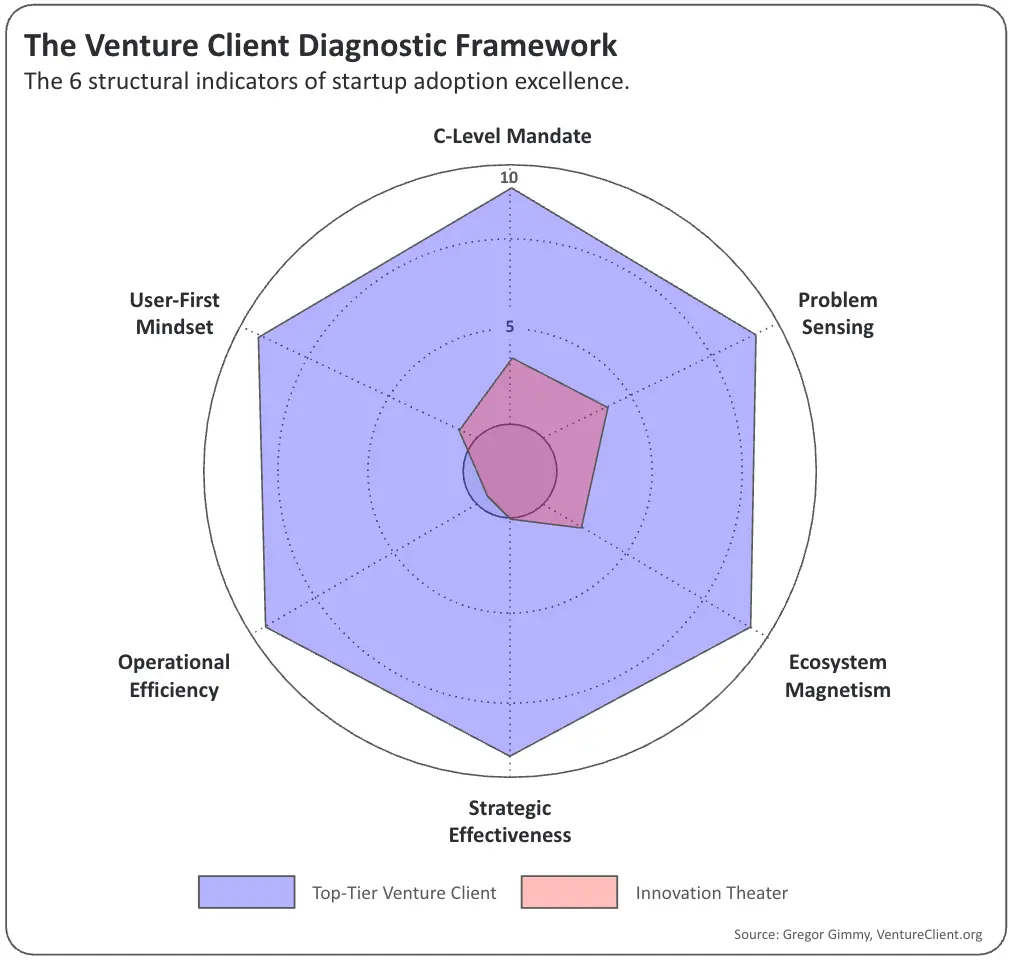
What distinguishes a highly effective Venture Client from the rest of the market? The answer lies in six structural indicators. These indicators form a diagnostic framework to evaluate the maturity, seriousness, and potential impact of a firm’s startup adoption capabilities.
As illustrated in Figure 1, this framework clearly separates top-tier execution from the common trap of corporate innovation theater.
1. Formalized Strategic Purpose with explicit C-Level Mandate
Focus: Defining the relevance of startup solutions in the corporate strategy.
Check: Does startup technology adoption have a strong strategic priority, formally decided at the board level?
When this strategic purpose is ill-defined, the entire adoption capability starves. Without the CEO actively championing the discipline, the Venture Client team will lack critical resources, including budget for personnel, adoption projects, and strategic M&A. Internal business units will not take the initiative seriously, causing adoption cycles to stall or fail. The effort inevitably devolves into “innovation theater.” The team becomes marginalized as a PR exercise—a group of people in sneakers running around incubators just to make the legacy business look modern. Because it lacks a mandate to solve actual business problems, the unit is reduced to generating superficial marketing content.
This internal dysfunction directly destroys external credibility. Top-tier startups are highly sensitive to friction and operational drag. If they sense a lack of executive commitment, they will anticipate long sales cycles, high customer acquisition costs, and the risk of being slowed down with no strategic upside. Consequently, they will walk away. A missing C-level mandate makes the firm’s Venture Clienting ineffective, resulting in poor capabilities that actively scare off the exact startups capable of moving the needle.
2. Sensing the Startup Gap: Maximizing Problem Identification and Anticipation
Focus: Sensing known and unknown needs that startups solve best.
Check: What is the volume and level of urgency of startup-relevant problems, both known and unknown?
The volume and urgency level of startup-relevant problems a firm identifies is a critical indicator of its Venture Clienting maturity. Venture Clienting is fundamentally a discipline for solving strategic problems. Startups are founded and funded precisely to solve complex business needs better than incumbents. Therefore, the total number and severity of identified needs—what I call the “startup gap”—serves as the foundational indicator for the quality of a Venture Clienting capability. Without a substantial, continuous flow of unsolved strategic challenges, even the best-resourced Venture Client Unit will generate little impact, as the startup gap remains wide open.
A top-tier Venture Client systematically unearths both known internal problems and unknown strategic needs. Closing the startup gap requires more than just matching an existing internal complaint to an external vendor. Good Venture Clients acknowledge that top entrepreneurs discover and solve critical issues that established firms do not even realize they have. Therefore, quality Venture Clients proactively monitor the startup ecosystem to anticipate and describe the urgency of these unarticulated needs. By doing so, the unit leverages the startup ecosystem not just as a highly relevant pool of innovative vendors and acquisition targets, but as a strategic radar for future competitive challenges.
Good Venture Clients identify a large volume of high-impact problems: hundreds per year for large enterprises, and dozens for SMEs. If solved, these add hundreds of millions in revenue and cost advantages. A reliable proxy to size the gap, in volume and relevance, is the number of VC-backed startups and their valuations. Both have been growing substantially over the last decade, which suggests that the number and relevance of needs that startup solutions can uniquely address has also grown significantly. Today, early-stage valuations often exceed $100 million. Thousands of these highly valued startups are addressing just about any part of a company’s value chain across all major sectors: industrial, service, and financial. With over 100,000 active VC-backed startups globally—tens of thousands dedicated to R&D, manufacturing, marketing, or HR alone—the statistical probability that a firm only has ten “nice-to-solve” problems that startup solutions address with superior quality is practically zero. Leading Venture Client Units prove this scale; for example, Bosch’s Venture Client Unit, Open Bosch, detects hundreds of problems every year that result in adoptions to address a vast array of internal needs, generating hundreds of millions in competitive impact.
Failing to sense the startup gap correctly means critical opportunities are missed and hidden risks remain undiagnosed. A strategic opportunity cannot be seized if you are blind to the existence of an underlying problem. If you can only come up with ten problems per year, your Venture Client Unit is seriously underperforming. A rigorous problem-sensing capability is therefore an essential pillar for good Venture Clienting. However, identifying a large flow of problems is only valuable if the firm can attract the absolute best startups to solve them, which brings us to the next critical indicator: ecosystem magnetism.
3. Ecosystem Magnetism: Attracting Top-Tier Startups
Focus: Counterparty quality and adverse selection.
Check: Are the adopted startups backed by top-tier VC funds, and do their valuations rank in the top percentiles of their segment?
Top-tier startups are critical because they generate the highest strategic impact at the lowest operational risk. The strategic impact of a Venture Client strongly depends on its ability to attract the startups with the absolute best solution, not just average ones. While solutions exist on a continuum, the venture ecosystem operates on a power law where the distance between the best startup and the second-best can be massive. In the incumbent world, a firm might safely settle for a second-tier vendor to save costs. In the startup world, however, a B-class venture technology may not only deliver less impact, but it also carries risks that can result in negative outcomes. A good Venture Client knows it is not in the business of developing startups and does not waste resources trying to “fix” them. Therefore, a top-tier Venture Client does not settle for average; it strictly adopts solutions from the elite tier to guarantee positive impact and neutralize risk.
Identifying and attracting these elite startups is exceptionally difficult, making ecosystem magnetism a key indicator of a good Venture Client. The best founders hold the highest negotiation power. The ratio of elite startups to mediocre ones is roughly one to a thousand. The mediocre ones will aggressively pitch their solutions, claiming they can rule the world. The elite ones, however, do not need your firm to survive; they have ample capital and their pick of clients. To win them, the Venture Client must offer a flawless, high-speed adoption process that respects the startup’s time and resources. If a firm lacks this operational magnetism, it will suffer from adverse selection, attracting desperate, low-tier startups that ultimately destroy value.
Startup valuations are a highly reliable metric to measure this attraction capability—the higher the valuation, the better. The venture capital valuations and funding levels of adopted startup solutions serve as a strong proxy for both quality and potential impact, driven by the ruthless, highly efficient selection processes of top-tier VCs. A high valuation indicates that the startup is solving a relevant strategic problem and is de-risked against failure. This also exposes a fundamental flaw in CVC, which often seeks low valuations to acquire cheap equity. A good Venture Client, conversely, targets startups in the top percentiles of their segment because a higher valuation equals greater maturity and larger strategic impact.
While finding and attracting these elite startups is the mandatory prerequisite, the good Venture Client must then translate that potential into actual competitive advantage, which brings us to strategic effectiveness as the next indicator.
4. Strategic Effectiveness: Delivering Substantial Value
Focus: Maximizing the impact of adopted startup solutions on competitiveness.
Check: Do the adopted solutions create a competitive advantage, measured through financial indicators such as revenue increase and cost reduction?
The magnitude of competitive advantage generated through the adopted startup solution indicates the strategic effectiveness of a Venture Client organization. Identifying a problem is only the prerequisite; true execution lies in actually solving it. This competitive advantage extends far beyond vague notions of “innovation.” It requires actual usage. A startup solution must be fully deployed and utilized within the firm’s operations or products for any real advantage to materialize. Therefore, a top-tier Venture Client measures its effectiveness strictly by the tangible business value created through active usage, rather than the mere number of startup contracts signed.
The ultimate metric to quantify this competitive advantage—and thus the impact achieved—is direct revenue generation or cost savings. Every business problem has a quantitative financial measurement. A slow internal process costs money, a superior product feature increases sales, and a cybersecurity vulnerability risks catastrophic data loss. While operational KPIs like the number of pilots or identified problems are relevant health metrics, the final assessment of effectiveness always comes down to the bottom line. If the adoption of a venture technology does not ultimately translate into measurable financial impact, the adoption was not strategically effective.
A highly effective Venture Client generates over €100 million in competitive advantage annually, or at least €1 million per problem solved. For SMEs, this target scales proportionally, but the underlying logic remains the same: startups are funded on the premise of solving massive problems, which translates into high revenue or profit impact. They offer exponential improvements, delivering technologies that are ten times better, faster, or cheaper than incumbent alternatives. To capture this, good Venture Clients define a concrete business case for every problem solved, making the strategic benefit strictly measurable. This competitive impact moves the needle for the entire firm, dwarfing the potential financial returns of a minority equity stake, which might please a CFO but rarely alters the company’s market position. A prime example is BMW’s adoption of Embotech’s autonomous driving software for factory automation, which yielded massive, immediate efficiency gains.
Ultimately, high strategic effectiveness means productively translating a large flow of identified problems into deployed, value-generating solutions—a feat that requires extreme operational efficiency, which is our next indicator.
5. Operational Efficiency: Speed and Cost of Adoption
Focus: Optimizing the process and resources employed to accomplish effectiveness.
Check: Is the input (cost, time) required to adopt startup solutions lower than the output (revenue, profitability) these generate?
Operational efficiency is the necessary counterpart to strategic effectiveness. If the cost and time required to adopt a startup solution exceed its strategic impact, the firm gains no competitive advantage. Instead, it creates a disadvantage. Efficiency is a strict function of the resources consumed to execute Venture Clienting activities over a given period. Internal inputs include the cost of personnel, infrastructure, tools, and data. External inputs include the capital required to validate and integrate the technology, paid either to the startup via a purchase order or to its shareholders via an acquisition.
Optimizing this efficiency requires a well-orchestrated Venture Client Model. The primary drivers are a strong C-level mandate, a dedicated team, and high-quality tools and data that enable Venture Clienting processes to function smoothly. However, efficiency also depends heavily on the cultural acceptance of startup technology. A highly efficient machine for sensing problems and sourcing top startup solutions comes to an abrupt halt if internal business units refuse to integrate them. Building a strong Venture Clienting culture is a critical, yet often overlooked, factor in neutralizing organizational friction and maximizing operational efficiency.
A well-functioning operation ensures that a high volume of strategic problems is solved efficiently year over year, scaling flexibly to meet internal demand. An efficient Venture Client Unit typically initiates operations by executing five to fifteen adoption projects in its first year, involving three to five distinct business units. As proficiency grows, this volume doubles over the next three to four years, with mature firms integrating well over 100 startup technologies annually. Speed is equally critical. Research shows that implementing a good Venture Client Model reduces the time from problem identification to the first signed contract from over two years to under three months. A two-year delay is not merely an administrative friction; it represents a massive opportunity cost where competitors can adopt and scale that exact same technology faster. Therefore, the benchmark cycle must take less than twelve weeks, and the conversion rate from initial adoption to scaled usage must exceed 50 percent.
While productivity indicators are mandatory for any standard business function, traditional corporate venturing approaches like CVC do not use them. A non-controlling minority investment cannot measure the strategic effectiveness of a technology, nor the operational efficiency of its deployment. The CVC’s mandate and expertise are strictly limited to the financial transaction, meaning it can only be held accountable for financial ROI versus the cost of capital. The actual impact-generating technology transfer remains the sole responsibility of the problem-owning business unit: the Venture Client. Therefore, another relevant indicator for a high-quality Venture Client is its ability to rigorously measure both its strategic effectiveness and operational efficiency, which leads directly to our next indicator.
6. The “User-First” Mindset: Adoption as the Driver of Value Capturing
Focus: Governance logic and cultural alignment.
Check: Is there formal communication, training, and incentivization to embrace the adoption of startup technology as a strategic resource across the firm?
The defining governance logic of a good Venture Client is a “user-first” mindset, where the adoption of the startup’s technology is understood as the primary and necessary driver of strategic value. This contrasts with traditional corporate venturing, where equity investment acts as the driver of strategic value capturing. This does not mean a firm cannot operate separate financial investment vehicles. However, when the objective is to enhance core products and processes, any financial transaction—from a standard purchase order to a controlling M&A—must serve the goal of adopting the technology. If a secondary financial goal of capitalizing on the startup’s valuation is added to the primary objective of utilizing the product, the firm dilutes its focus and compromises its effectiveness as a Venture Client.
This user-first mindset protects the good Venture Client from the structural distractions inherent to the venture ecosystem, particularly the speculative upside promised by startup investments. High-stakes financial bets are generally misaligned with a firm’s strategic purpose. BMW, for example, does not make money from startup equity; it makes money from selling cars. A good Venture Client avoids the equity trap, yet it does not reject investment entirely. If exclusive control over a game-changing technology is required to secure a competitive advantage, a controlling investment (M&A) becomes a highly effective adoption tool. Therefore, a mature Venture Client demands that investment acts strictly as a mechanism to guarantee usage.
Ultimately, this mindset acts as the cultural capstone that keeps the entire corporate venturing operation aligned with the firm’s core business. When the organization understands that startups are providers of strategic solutions rather than assets for financial speculation, internal dynamics change. Business units proactively seek startup technologies to solve relevant problems, and generic routines are adapted to adopt their solutions efficiently. To audit this cultural shift, a firm must measure its internal enablement: the number of formal training sessions conducted, the frequency of C-level communications, and the implementation of incentive systems like internal awards and storytelling campaigns. By formally embedding adoption as the necessary condition, the firm ensures its engagement with the venture ecosystem consistently drives tangible, operational impact.
The Pathway to Excellence: Building a Strong Venture Client Model
Achieving high marks across the six structural indicators requires more than good intentions; it requires a formalized Venture Client Model. While based on a best-practice framework, this model must be customized to the specific operational realities of the firm. It defines the strategy, processes, and resources a firm needs to systematically sense problems, attract top-tier startups, and execute their adoption efficiently. By formalizing these elements, the Venture Client Model transforms opportunistic startup interactions into a repeatable, highly impactful business discipline.
Institutionalizing this Model requires a dedicated organizational vehicle: the Venture Client Unit. Establishing a Venture Client Unit is no different from establishing any other critical business function. If a firm wants to excel at marketing, it builds an in-house marketing department. If it wants to excel at startup adoption, it requires an in-house team of Venture Clienting professionals. The Venture Client Unit orchestrates the adoption process, guides internal business units, and manages the external ecosystem interface. While a high-performing Venture Client Unit actively leverages external tools, data, and specialized agencies, the core orchestration capability must reside in-house to guarantee cultural fit, strategic alignment, and operational speed.
Conclusion: The Strategic Imperative of Startup Adoption
Venture Clienting—defined as the practice of adopting startup technology to innovate products and processes—is a strategic imperative for the modern enterprise. The venture ecosystem consistently produces high-impact solutions that address unsolved, critical business needs. Firms that master this discipline gain a significant, compounding competitive advantage. The strategic question for the C-suite is no longer whether to utilize startup solutions, but how to execute Venture Clienting with excellence.
This article offers a framework of six structural indicators to define and assess high-impact Venture Clienting. A good Venture Client operates with a clear C-level mandate, proactively senses the startup gap, attracts top-tier startups, and executes with efficiency to deliver measurable business value. Crucially, it maintains a strict user-first cultural mindset, ensuring the firm focuses on the adoption of startup solutions to capture strategic value.
Institutionalizing Venture Clienting through a robust Venture Client Model ensures high marks across these six indicators of excellence. This enables firms to leverage the global startup ecosystem as a powerful engine for continuous innovation and growth.
Author’s note
I originally published a foundational version of this article in 2021.
This article is based upon over ten years experience in implementing Venture Clienting at over 30 corporations, beyond BMW, at global leaders such as Airbus, Bosch and Siemens Energy.
Image Credit: Copyright BMW Group, Design by Pol Pascual.
Video Credit: Copyright BMW Group.
Recommended Readings
For a rigorous understanding of how firms strategically adopt venture technology, explore the Venture Client Thinking Library, a curated hub of publications on the discipline.
To master the underlying logic, review the Foundations of Venture Clienting. These foundations provide the official definition, principles and standards upon which organizations establish this capability as a distinct business discipline, enabling strict governance, comparability, and academic research.
Mastering the Discipline (Venture Client Foundations)
- Venture Clienting: Definition & Boundaries
Dive deeper into the structural differences between usage-centered and equity-driven corporate venturing.
- The Venture Client Unit
The blueprint for institutionalizing the capabilities required to execute the 6 structural indicators.
Industry Validation & Case Studies
- When Goliath Needs David: How Corporations and Startups Are Redefining Corporate Venturing
Wharton research demonstrates that staying competitive requires firms to adopt innovations faster and cheaper than traditional CVC allows, highlighting Venture Clienting as the key mechanism to achieve this.
- Why Companies Do Innovation Theater Instead of Actual Innovation (Harvard Business Review)
A candid look at why generic corporate venturing fails.
- The BMW Startup Garage (INSEAD Business School)
The academic case study on the genesis of the world's first dedicated Venture Client Unit.
Related Articles
- Venture Client Model: Reaching New Heights on the Gartner Hype Cycle
The Venture Client Model made it to the Gartner Hype Cycle. Learn what this means, and how this model is transforming corporate venturing.