article
Venture Client Model: Reaching New Heights on the Gartner Hype Cycle
Gartner spotlights the Venture Client Model—here’s what that means for corporate venturing.
Summary
The Venture Client Model is a corporate venturing practice that enables companies to generate direct strategic impact by adopting startup technologies early—faster, at lower cost, and with less risk than traditional corporate venturing models.
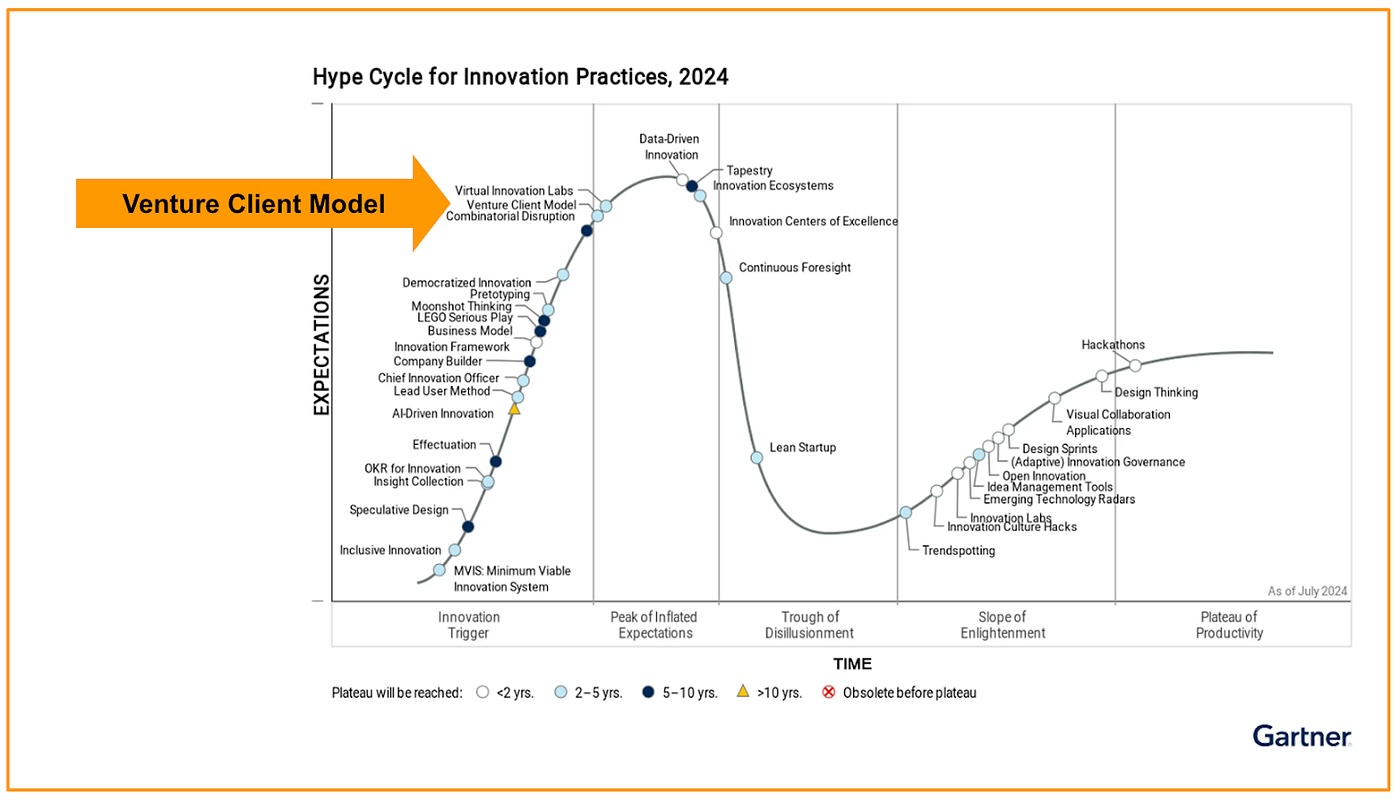
The Venture Client Model has now reached a major milestone: it has been included in the 2024 Gartner Hype Cycle for new Innovation Practices and is currently positioned at stage 2, the Peak of Inflated Expectations. This article explains what this placement means, why the Venture Client Model has gained global relevance, and how it differs structurally from established corporate venturing approaches such as corporate venture capital and accelerators. It also outlines the challenges that lie ahead as the model moves from hype toward long-term productivity and institutionalization.
Understanding the Gartner Hype Cycle in Corporate Innovation
The Gartner Hype Cycle provides a structured way to assess the maturity and adoption of emerging technologies and innovation practices over time. As a framework for innovation practices, the Hype Cycle helps organizations and academics understand not only emerging attention but also the maturity of business practices as they move toward real-world applicability.
The Hype Cycle is commonly used to:
- assess the maturity of innovation practices,
- distinguish hype from practical applicability,
- support strategic decision-making around emerging business practices.
Practices evolve over time through five key phases:
- Innovation Trigger: Initial breakthrough, early interest, and some high-profile success stories.
- Peak of Inflated Expectations: High excitement and hype, leading to potentially unrealistic expectations and media overexposure.
- Trough of Disillusionment: Realization of limitations, leading to waning interest and skepticism.
- Slope of Enlightenment: Practical applications emerge, and best practices develop as the technology matures.
- Plateau of Productivity: Widespread adoption and understanding of the technology’s benefits.
It is important to note that not all technologies and business practices successfully pass through every stage. Some may get stuck in the Trough of Disillusionment or even disappear after the Peak of Inflated Expectations due to factors such as market conditions or inherent limitations. For those innovations that do make it to the Plateau of Productivity, the path through the Hype Cycle stages illustrates their journey toward maturity and widespread adoption.
The Significance of Stage 2: Peak of Inflated Expectations
For any new technology or innovation practice to be featured on the Gartner Hype Cycle is an achievement in itself. Being positioned at stage 2 signifies that the Venture Client Model has garnered significant attention and interest within the industry. This recognition suggests that the Venture Client Model is an impactful and transformative practice.
However, while reaching stage 2 is a notable milestone, it also marks the beginning of a critical journey. The challenge now lies in navigating through the subsequent stages and ultimately reaching the Plateau of Productivity, where the Venture Client Model can demonstrate consistent, tangible benefits and widespread adoption.
In essence:
- Visibility and Recognition: Being featured on the Hype Cycle means the Venture Client Model is recognized as potentially impactful and innovative. This visibility will likely attract more corporate adopters and spark more academic research of the Venture Client Model.
- Validation: Reaching the Peak of Inflated Expectations suggests that the Venture Client Model has demonstrated promise and generated excitement within corporations.
- Challenges Ahead: While reaching stage 2 is a positive milestone, it also marks the beginning of a critical period. The transition from hype to practical application is challenging, and many technologies struggle during the Trough of Disillusionment.
- Long-term Focus: The ultimate proof that the Venture Client Model is institutionalized as a valuable business practice is reaching the Plateau of Productivity, demonstrating its widespread adoption and consistent value generation.
In summary, being in stage 2 of the Hype Cycle is a significant accomplishment. However, the journey to stage 5 involves overcoming substantial challenges and proving the long-term value of the model.
The History of the Venture Client Model and Venture Clienting
The term Venture Clienting and the Venture Model were born at BMW. It all started in 2014 when I was working at BMW R&D as an Innovation Manager. I sought a way for BMW to better obtain strategic benefits from startup adoption, specifically through the adoption of startup technologies in products and processes. The existing models, such as corporate venture capital (CVC) and accelerators, did not meet my requirements. I needed a model that was scalable (to benefit from as many startups as needed, not limited to less than 10 per year as in CVC) and one that would give BMW access to the very best startups. The CVC model did not guarantee this, as the best startups often do not want any (or another competing corporate) on their cap table. Additionally, I found traditional corporate venturing models too costly and risky, requiring millions to be invested for a non-controlling minority stake without knowing if a given startup technology would work or be accepted by corporate users.
I realized that the ultimate goal of corporate venturing is not to invest but to obtain strategic benefits from the usage and adoption of startup technology. Investment, I believed, is not a necessary condition to obtain such a benefit. So, I proposed skipping the investment stage and instead positioning BMW as a client, i.e., a user of startup technology. This idea led me to coin the term “Venture Client” to describe an early client and user of startup technology, in alignment with the term “Venture Investor” that describes the investor in a startup company. Although BMW and many other corporations had been Venture Clients of startups (buying and using startups’ technologies), there was no specific model (including processes, resources, and value systems) for excelling in this. Just as Venture Capital is a distinct model for providing capital to startups, I developed a Venture Client-specific model to enable BMW to benefit strategically at scale, across the entire value chain, measurably, and with low cost and risk from the best startups worldwide. This marked the birth of the Venture Client Model as a novel innovation practice.
One key element of my Venture Client Model was to create a dedicated and branded organizational unit with the sole mission of harnessing strategic benefits from startups through Venture Clienting — through the usage and adoption of leading startup technology for relevant problems that startups were better at solving than BMW. This gave birth to the BMW Startup Garage in February 2015, the very first corporate Venture Client Unit.
Find more information about the origins and definition of the Venture Client Model in the Foundations Definition, and explore further context, references, and historical material in the VentureClientThinking Library.
How Did the Venture Client Model Make It to the Gartner Hype Cycle of Novel Innovation Practices?
I see four interrelated reasons why the Venture Client Model was recognized by Gartner on the Hype Cycle as a relevant novel innovation practice for companies across industries. Together, these reasons explain not only the model’s growing visibility, but also its underlying maturity: proven effectiveness in generating strategic impact, widespread adoption across corporations of different sizes and sectors, increasing academic recognition as a distinct corporate venturing approach, and the emergence of a dedicated Venture Client Solutions market that enables scalable and professional execution. Taken together, these factors signal that the Venture Client Model has evolved from an experimental idea into a structurally grounded practice within modern corporate venturing.
1) Demonstrated Effectiveness
The Venture Client Model works substantially better than alternative corporate venturing models. BMW boosted the number of startups it engaged with by a factor of 10, while also significantly reducing the cost and time needed to access these startups. I am observing the same positive results at multiple corporations that correctly adopt the Venture Client Model.
2) Widespread Corporate Adoption
Since BMW adopted the first Venture Client Model, many corporations across over ten industries worldwide have followed suit. Since starting 27pilots, we have helped over 50 corporations, including Airbus, Bosch, BSH, Holcim, MTU, Siemens Energy, and Otto, establish strong Venture Client capabilities. With the Venture Client Model, even SMEs and family-owned corporations can benefit from the best startups.
3) Academic Recognition and Institutionalization
Besides promoting the adoption of the Venture Client Model by companies, I have been actively supporting and advancing academic work related to Venture Clienting since 2015. In November 2015, I introduced the model to Prof. Andreas König (Universität Passau), who immediately recognized it as a game-changer in corporate venturing. Following this, institutions like IMD (Prof. Albrecht Enders) and INSEAD (Prof. Jörg Niessing) began researching, writing case studies, and teaching the Venture Client Model.
Prof. Andreas König stated in my book:
“The first time I heard Gregor Gimmy present the Venture Client Model in 2015, I instantly felt it was a game-changer. This was not just another corporate venturing strategy — it was a radical rethinking of how companies can strategically benefit from startups. Since its inception, the model has not only been a catalyst for change in the business world but has also ignited a wave of academic research and classroom discussions. “Buy, Don’t Invest” articulates this disruptive approach in a style that is as direct as it is insightful. The book includes many rich real-world examples and anecdotes from established industry icons like BMW as well as Silicon Valley titans like Apple and Google. It is the central, state-of-the-art resource for anyone interested in understanding and teaching the Venture Client Model and its application in modern agile companies. Whether you are an academic or a business leader, if you are looking for a groundbreaking, novel perspective on corporate venturing, this book deserves a special place on your bookshelf.”
I am proud that today, many more leading universities worldwide are teaching and researching the Venture Client Model, such as: ETH Zurich (Prof. Stephan Wagner), WHU – Otto Beisheim School of Management (Prof. Nadine Kammerlander) and HHL Leipzig Graduate School of Management (Prof. Dominik Kanbach).
See the HBR article and the INSEAD case—two of the earliest and most influential academic publications on the Venture Client Model.
4) Emergence of a Venture Client Solutions Market
In 2018, I left the BMW Startup Garage and founded 27pilots, the first company fully dedicated to helping corporations build and operate effective Venture Client Units based on the Venture Client Model framework I developed at BMW. The goal was to enable scalable and effective adoption of startup technologies within established organizations—addressing structural limitations of traditional corporate venturing approaches. Since then, many leading professional services and technology companies have begun offering Venture Client Solutions, reflecting the growing adoption, scalability, and proven effectiveness of the Venture Client Model across industries. The pioneer in this emerging market was Deloitte, which acquired 27pilots in 2023 and has since established a global Venture Client Solutions offering, spanning from Germany to Japan.
Taken together, the demonstrated effectiveness of the Venture Client Model, its widespread corporate adoption, its growing academic recognition, and the emergence of a dedicated Venture Client Solutions market explain why Venture Clienting has reached the Gartner Hype Cycle as a mature and relevant practice within corporate venturing
Recommendations for the Future
To ensure that the Venture Client Model does not succumb to the Trough of Disillusionment (stage 3), we must continue to produce high-quality academic research and provide superior consulting, technology, and data services. This will enable corporations to achieve true Venture Client excellence, generating substantial strategic impact from cutting-edge startup innovations. It is crucial that academics, and especially consultancies and tech providers, do not merely rebrand outdated and often ineffective venturing models as Venture Client practices. They must genuinely adopt the transformative process, resources, and value systems that make the Venture Client Model so powerful.
We must all collaborate to further improve and refine the Venture Client Model. It is essential for Venture Client service and tech providers to avoid a price war that could degrade the quality of our deliverables and thus the strategic impact and relevance of corporate Venture Client Units. Such a race to the bottom would not only stall our ability to innovate this novel model but also risk undermining its core value proposition. Instead, we should focus on fostering a culture of continuous improvement, leveraging high-quality research, and embracing innovative methodologies. By maintaining the integrity and effectiveness of the Venture Client Model, we can ensure it remains a powerful tool for driving strategic benefits from startups.
In conclusion, the inclusion of the Venture Client Model on the Gartner Hype Cycle is a testament to the hard work of visionary BMW and 27pilots Venture Client teams, and all pioneers working in Venture Client Units at corporations and universities across the globe. As we — the community of Venture Client practitioners and academics — continue this journey, we are committed to demonstrating the model’s value, overcoming challenges, and driving innovation in corporate venturing practices. Stay tuned for more updates as we strive to reach new heights and achieve widespread success.
Conclusion
The inclusion of the Venture Client Model on the Gartner Hype Cycle underscores that Venture Clienting has emerged as a credible and increasingly influential approach within modern corporate venturing. By focusing on the early adoption of startup technologies rather than financial participation, the Venture Client Model enables companies to capture strategic value directly in their core business—more quickly, with lower cost, and with reduced risk compared to traditional venturing approaches.
As the model progresses beyond the Peak of Inflated Expectations, its long-term success will depend on disciplined execution, dedicated Venture Client Units, and the ability to consistently translate startup adoption into measurable business impact. If these conditions are met, Venture Clienting is well positioned to move from a highly visible innovation practice to a stable and productive pillar of corporate venturing.
In essence, the Venture Client Model positions Venture Clienting as a more effective form of corporate venturing by enabling companies to achieve direct strategic impact through early startup adoption rather than indirect financial investment.
More information
- Gartner: Hype Cycle for Innovation Practices, 2024
- Book about the Venture Client Model: Buy, don’t invest: The Venture Client Model: A Paradigm Shift in Corporate Venturing
- Harvard Business Review about the emergence of the Venture Client Model at BMW: What BMW’s Corporate VC Offers That Regular Investors Can’t
- INSEAD Case about the first corporate Venture Client Unit: How Corporates Co-innovate with Startups: The BMW Startup Garage